



The afterglow Standards: How We Curate the Best Intimate Films for Women
You’ve probably noticed: most platforms categorize intimate content like you’re browsing a hardware store. Body types. Acts. Scenarios. As if what makes something arousing can be sorted by physical specifications.
We think that’s insulting to your intelligence.
At afterglow, we believe what actually turns you on—what makes content worth watching—has almost nothing to do with those surface-level categories. It’s about presence. Authenticity. Connection. The ineffable quality that makes you want to stay in the moment rather than scroll to the next thing.
This article breaks down exactly how we ensure every film in our catalog meets standards you won’t find anywhere else. We’re pulling back the curtain on our two-stage evaluation process, the research that validates our approach, and why thinking about intimate content through our Four Auras framework changes everything.
Why Most Platforms Get Curation Completely Wrong
The Algorithm Problem: What Research Shows About Women’s Arousal
Recommendation algorithms work brilliantly for products and reasonably well for music. They fail spectacularly at predicting what women find arousing.
Here’s why: Women’s sexual arousal is fundamentally contextual and variable—not fixed and predictable.
A comprehensive 2010 meta-analysis led by Dr. Meredith Chivers analyzed 134 studies on sexual arousal and found that the correlation between women’s physiological arousal and their subjective experience is remarkably low (r = .26). More importantly, the meta-analysis revealed tremendous between-person variability in what women respond to.
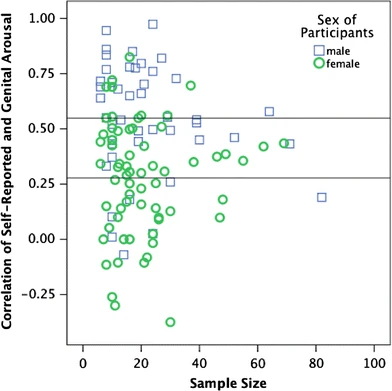
What this means: What turns you on today might not turn you on tomorrow. The specific scenario or performer that worked last Tuesday might do nothing for you Friday. And that’s completely normal.
A 2020 theoretical review in Archives of Sexual Behavior by Timmers emphasized that context matters more than content for women’s arousal. Stimuli featuring partnered interaction elicited different responses compared to solitary acts—highlighting that what’s happening around the sexual activity matters as much as the activity itself.
The Category Trap: Physical Attributes Don’t Predict Arousal
Most platforms categorize content by observable characteristics: body types, specific acts, participant configurations. But research shows this misses what actually matters.
A 2023 study by Maas et al. published in the Journal of Sex & Marital Therapy examined pornography preferences among 206 women and identified four distinct preference patterns—and crucially, these patterns weren’t based on physical attributes.
The patterns were:
- Heterogeneous (39%): Women who endorsed multiple genres
- Traditionally Feminine (27%): Preference for socially acceptable depictions, massage-focused content
- Female Pleasure (23%): Strong preference for content depicting female orgasms
- Rough/Violent (11%): Preference for aggressive content, less interest in emotional connection
What mattered wasn’t the bodies or acts—it was the psychological and relational characteristics of the content.
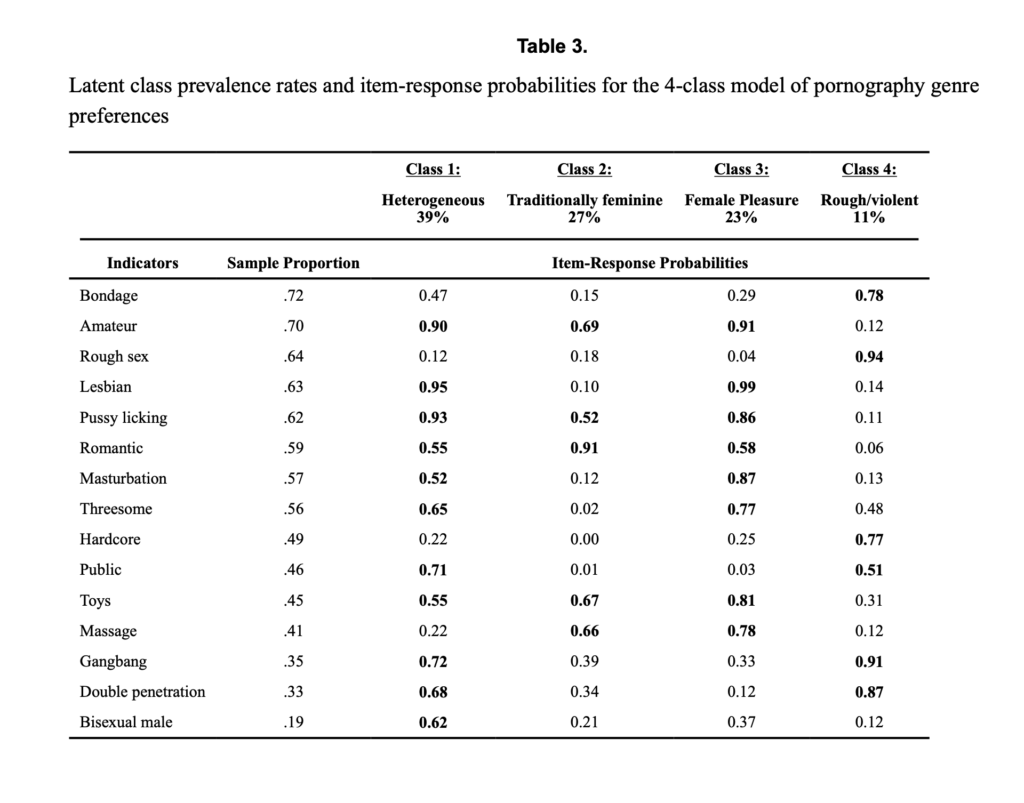
This validates what we’ve built at afterglow: psychological factors predict arousal far better than physical categories.
What Women Actually Respond To: The Eye-Tracking Evidence
If physical attributes don’t predict arousal, what does?
Groundbreaking eye-tracking research provides answers.
Women Look at Faces and Context, Not Just Bodies
A landmark 2007 study by Rupp & Wallen published in Hormones and Behavior used eye-tracking technology to measure exactly where men and women looked while viewing sexual images.
The findings were striking:
Men:
- Spent significantly more time looking at female faces
- Focused primarily on faces and bodies
- Paid little attention to background or context
Women:
- Looked at genitals comparably to men
- Spent significantly more time looking at contextual elements—clothing, background, setting, facial expressions
- Processed the scene holistically rather than focusing on specific body parts
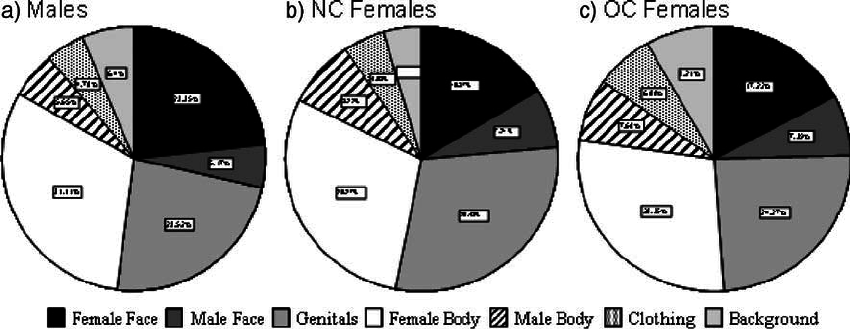
What this means for curation: Women process intimate content holistically. You’re not just evaluating bodies or acts—you’re taking in the entire scene, the connection between people, the authenticity of the moment.
Faces, Expressions, and Connection Matter More Than You Think
Further eye-tracking research reinforces just how much context and presence matter.
Rupp and Wallen’s 2007 study found that men looked at female faces significantly more than women did, but women paid substantial attention to contextual elements: the overall situation, background details, and relational dynamics between performers.
Research by Nummenmaa et al. (2012) added crucial nuance: while first fixations almost always landed on faces before moving to chest and pelvic regions, those fixations on genital areas were only associated with elevated physiological arousal when the overall scene conveyed presence and genuine engagement.
The physical attributes weren’t irrelevant, but they weren’t the whole story. Context mattered. Emotional intensity mattered. The sense that people were actually present with each other—that mattered most of all.
This supports afterglow’s emphasis on Presence and Authenticity—you’re looking for genuine human connection, not just visual stimulation.
The afterglow Solution: A Two-Stage Evaluation System
We don’t upload content and hope for the best. Every film undergoes rigorous human evaluation before reaching the platform.
Stage 1: The Licensing Scorecard (Quality Gate)
Purpose: Ensure minimum quality standards and alignment with afterglow values.
Every film is scored on 7 criteria for a maximum of 19 points:
| Category | Points | What We Evaluate |
|---|---|---|
| Female Pleasure Focus | 1-3 | How centered and authentic female pleasure feels |
| Learnability | 1-3 | Educational potential—can viewers learn from this? |
| Turn-On Factor | 1-3 | Overall appeal and arousal potential |
| Subjective Enjoyment | 1-3 | Reviewer’s honest personal response |
| Authenticity | 1-3 | Emotional honesty and genuine presence |
| Cinematic Quality | 1-3 | Visual and artistic production value |
| Fresh Perspective | 0-1 | Bonus for unique/underrepresented content |
Decision threshold: 14+ points = Approved for licensing
This scoring system is rooted in what research tells us matters: authenticity, female pleasure, and genuine connection trump production value or specific physical attributes.
Stage 2: Four Auras Scoring (The Personality Description)
Once a film passes quality review, we describe its characteristics using our Four Auras framework. This isn’t about judging—it’s about helping you find what resonates with you right now.
For each aura, reviewers place the film on a 0-100 spectrum:
1. Authenticity Spectrum: Raw ↔︎ Balanced ↔︎ Cinematic
What we’re evaluating:
- How polished is the production?
- Do performers feel genuine or like they’re performing?
- Can you see real emotion and response?
Why this matters: Research consistently shows women value emotional authenticity in sexual content.
Scoring examples:
- 0-33 (Raw): Real couples, visible genuine reactions, amateur aesthetic
- 34-66 (Balanced): Professional but emotionally honest
- 67-100 (Cinematic): High production, polished, aspirational aesthetic
2. Presence Spectrum: Vanilla ↔︎ Balanced ↔︎ Kinky
What we’re evaluating:
- Are performers clearly present and connected?
- Does the camera focus on connection or just bodies?
- Is this about pleasure or visual appeal?
The research: A 2020 study by Velten et al. in the Journal of Sexual Medicine used eye-tracking to examine visual attention in women with and without arousal concerns. The key finding: Longer fixation on genital areas correlated with higher subjective AND physiological arousal—but only when the content felt present and engaged.
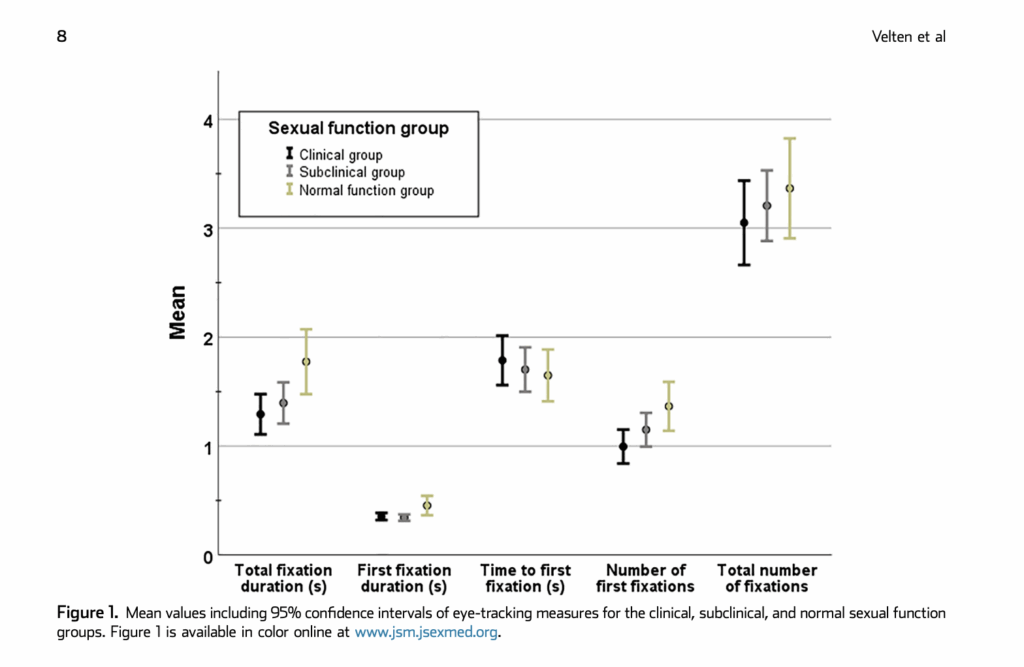
Presence—the sense that performers are actually absorbed in the moment—matters immensely for arousal.
3. Connection Spectrum: Tender ↔︎ Balanced ↔︎ Wild
What we’re evaluating:
- What’s the emotional tone and energy level?
- Soft and intimate or passionate and intense?
- How do the performers relate to each other?
The research: Women’s preferences for intensity are highly variable and context-dependent.
The Dual Control Model of Sexual Response (Bancroft & Janssen, 2000) established that sexual arousal involves both excitation and inhibition systems that respond differently based on context, mood, relationship factors, and individual differences.
This explains why you might crave tender connection one day and passionate intensity the next. Your nervous system isn’t inconsistent—it’s responding intelligently to your current state.
4. Communication Spectrum: Implied ↔︎ Balanced ↔︎ Explicit
What we’re evaluating:
- How much verbal communication is present?
- Do performers discuss desires, boundaries, preferences?
- Or is communication mostly through body language?
Why both ends of the spectrum have value: Some viewers want to see explicit negotiation and verbal consent. Others prefer watching bodies in wordless conversation. Both can be arousing, educational, and healthy—it depends on what you’re seeking.
Why Four Auras, Not Four Ratings?
You’ll notice we don’t rate films as “high authenticity = good, low authenticity = bad.”
These are descriptive spectrums, not quality judgments.
A film can be highly idealized (polished, cinematic) and excellent. Another can be maximally candid (amateur, raw) and equally excellent. The question isn’t which is better—it’s which matches what you want right now.
This approach is supported by research on recommendation systems and user satisfaction. While specific published studies comparing dimensional vs. categorical systems for sexual content don’t yet exist (this is afterglow’s innovation!), the broader recommender systems literature consistently shows that multi-dimensional profiling outperforms simple categorical systems for complex, preference-based recommendations.
What This Means for You: Practical Impact
You Can Finally Articulate What You Want
Most women struggle to answer “what kind of porn do you like?” The crude categories available don’t capture what actually matters.
But you can probably answer:
- “Do you want something more raw or more cinematic right now?”
- “Are you in the mood for tender or wild?”
- “Do you want to see explicit communication or implied connection?”
The Auras give you vocabulary for desires you’ve always had but couldn’t name.
You’ll Discover Content You Didn’t Know You Wanted
Because we describe films by how they feel rather than what’s in them, you’ll find unexpected matches.
Research by Maas et al. (2023) showed that 39% of women fell into the “Heterogeneous” preference class—meaning they enjoyed multiple genres that traditional categorization would never connect.
You might think you’re “not into” a particular scenario—until you find a version with the exact presence and authenticity you crave.
You’ll Learn What Actually Turns You On
Mainstream platforms train you to focus on surface attributes. The Auras retrain your attention towards what research shows actually predicts arousal: presence, connection, authenticity, communication.
Eye-tracking studies show women naturally attend to these elements—we’re just making them explicit and searchable.
Our Human-First Commitment
One final critical piece of our standards: Every film features real humans, really performing.
No AI-generated content. Ever.
As synthetic content floods the internet, we’re betting that audiences will increasingly crave genuine human connection. Authenticity becomes more valuable, not less, in an AI-saturated world.
Why this matters for curation:
- Human reviewers can detect genuine presence vs. performance
- No algorithm can score emotional authenticity
- Real connection between real people creates the tension algorithms can’t generate
- Your arousal deserves more than synthetic approximations
The Bottom Line
Most platforms treat intimate content like interchangeable widgets sorted by observable characteristics.
We treat it like what it actually is: complex human experiences deserving thoughtful curation.
Our two-stage evaluation ensures:
- Quality baseline (Stage 1: only the best make it through)
- Sophisticated description (Stage 2: find exactly what resonates)
The research is clear: what makes content arousing has far more to do with presence, authenticity, and connection than the surface-level categories dominating mainstream platforms.
We’re not just organizing content differently. We’re helping you develop a more sophisticated, shame-free relationship with your own desires.
Every film that reaches you has been watched, evaluated, and described by humans who understand what actually matters.
That’s the afterglow standard.
References & Further Reading
Key Studies Cited:
- Bancroft, J., & Janssen, E. (2000). The dual control model of male sexual response: A theoretical approach to centrally mediated erectile dysfunction. Neuroscience & Biobehavioral Reviews, 24(5), 571-579.
- https://pubmed.ncbi.nlm.nih.gov/10880822/
- Chivers, M. L., Seto, M. C., Lalumière, M. L., Laan, E., & Grimbos, T. (2010). Agreement of self-reported and genital measures of sexual arousal in men and women: A meta-analysis. Archives of Sexual Behavior, 39(1), 5-56.
- Full text: https://pmc.ncbi.nlm.nih.gov/articles/PMC2811244/
- Maas, M. K., Slaker, J., Holt, K., Ratan, R. A., Cary, K. M., & Greer, K. M. (2023). Sexual experiences and beliefs vary by patterns of pornography genre preferences among women. Journal of Sex & Marital Therapy, 49(6), 659-673.
- Full text: https://pmc.ncbi.nlm.nih.gov/articles/PMC10404303/
- Nummenmaa, L., Hietanen, J. K., Santtila, P., & Hyönä, J. (2012). Gender and visibility of sexual cues influence eye movements while viewing faces and bodies. Archives of Sexual Behavior, 41(6), 1439-1451.
- https://link.springer.com/article/10.1007/s10508-012-9911-0
- Rupp, H. A., & Wallen, K. (2007). Sex differences in viewing sexual stimuli: An eye-tracking study in men and women. Hormones and Behavior, 51(4), 524-533.
- Available on ResearchGate: https://www.researchgate.net/publication/6444160
- Timmers, A. D. (2020). Female genital arousal: A focus on how rather than why. Archives of Sexual Behavior, 49(8), 2863-2872.
- Full text: https://pmc.ncbi.nlm.nih.gov/articles/PMC8888380/
- Velten, J., Milani, S., Margraf, J., & Brotto, L. A. (2021). Visual attention to sexual stimuli in women with clinical, subclinical, and normal sexual functioning: An eye-tracking study. The Journal of Sexual Medicine, 18(1), 144-155.
- Full PDF: https://med-fom-brotto.sites.olt.ubc.ca/files/2020/12/Velten-et-al-2020.pdf
Want to experience the difference thoughtful curation makes? Explore films curated by women, for women, with standards that actually matter.